Research
Human Condition — Linguistic Condition
Cognitive Science and neurogenomics
Project Overview
My overarching goal is to understand what makes human children so good at learning languages and in so doing building a cognitive scaffold that serves them well throughout life. I like to approach this question from an evolutionary perspective. Not so long ago, evolutionary issues revolving around human language were considered “unsolvable” in principle.
Today the field of evolutionary linguistics, as it is sometimes called, is blossoming.
Key developments in several disciplines (paleo-genetics, neuroscience, archaeology, and comparative psychology) have contributed significantly to making language evolution empirically tractable.
For me, understanding human brain evolution and especially the modified early brain development that characterizes our species is absolutely critical to understanding what makes us human.
Here is a representative example of work I enjoy doing, in collaboration with Martin Kuhlwilm:
https://www.nature.com/articles/s41598-019-44877-x
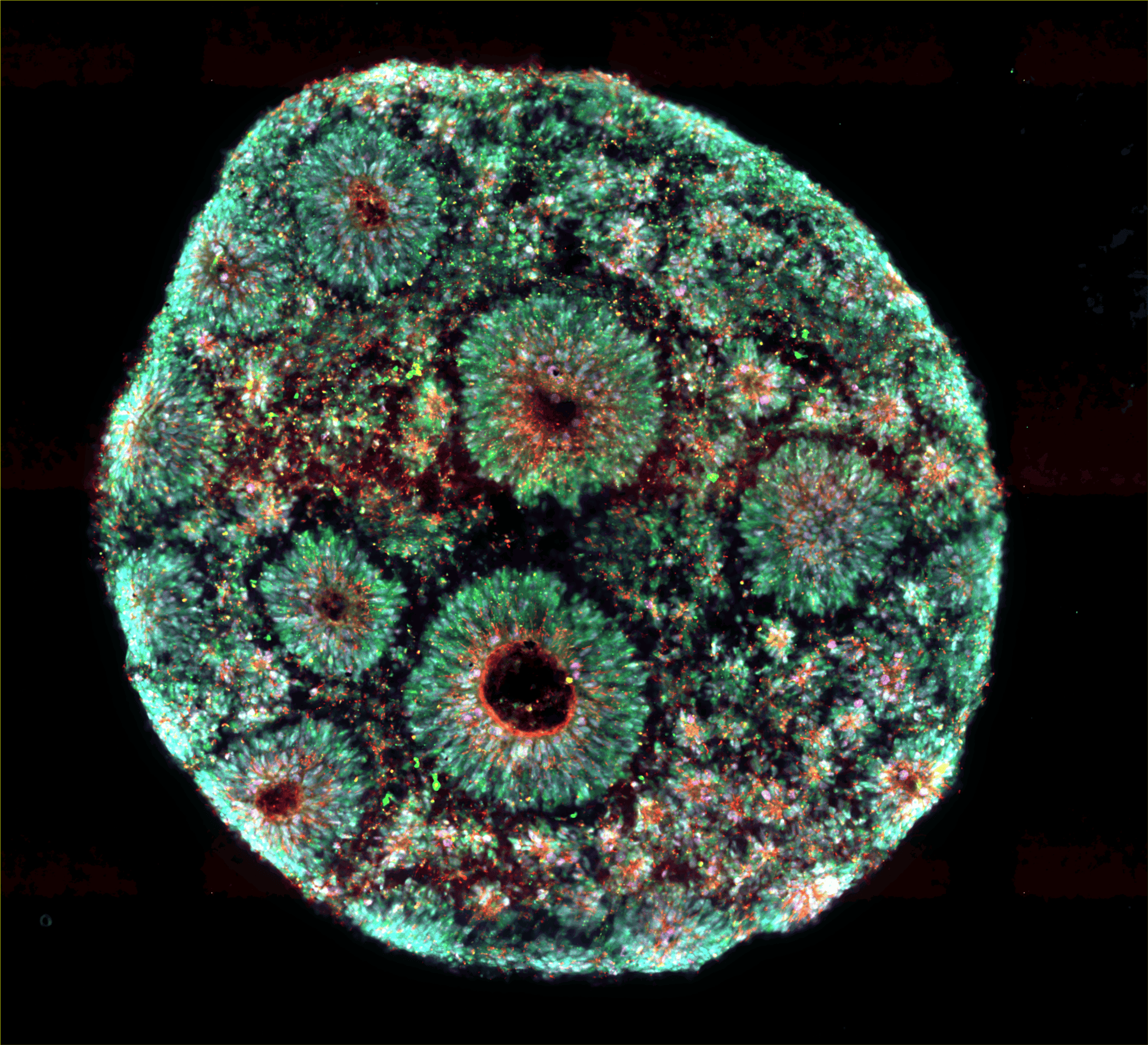
Together with Giuseppe Testa and Nael Nadif Kasri, I have sought ways to probe experimentally the neurobiological foundations of sapiens-specific cognitive-behavioral features. This has led me to the exciting world of brain organoids:
- https://www.biorxiv.org/
content/10.1101/2025.01.21. 634145v1; - https://www.biorxiv.org/
content/10.1101/2025.04.28. 651083v1; - https://www.biorxiv.org/
content/10.1101/2025.05.14. 653684v1
Early brain development does not happen in a vacuum, and my students and I have devoted a lot of effort into examining changes related to a specific prosocial profile, and our reduced reactive aggression. This work has led us to examine changes in neurotransmission (https://pubmed.ncbi.nlm.nih.
Two recent short pieces (https://pubmed.ncbi.nlm.nih.
Current grants
My current grant funded by the Spanish Ministry of Science and the National Research agency [PID2023-146627NB-I00] focuses on revisitng the nature of neoteny.